
What Are the Main Causes of Hair Fall?
March 16, 2026
·
15 min read
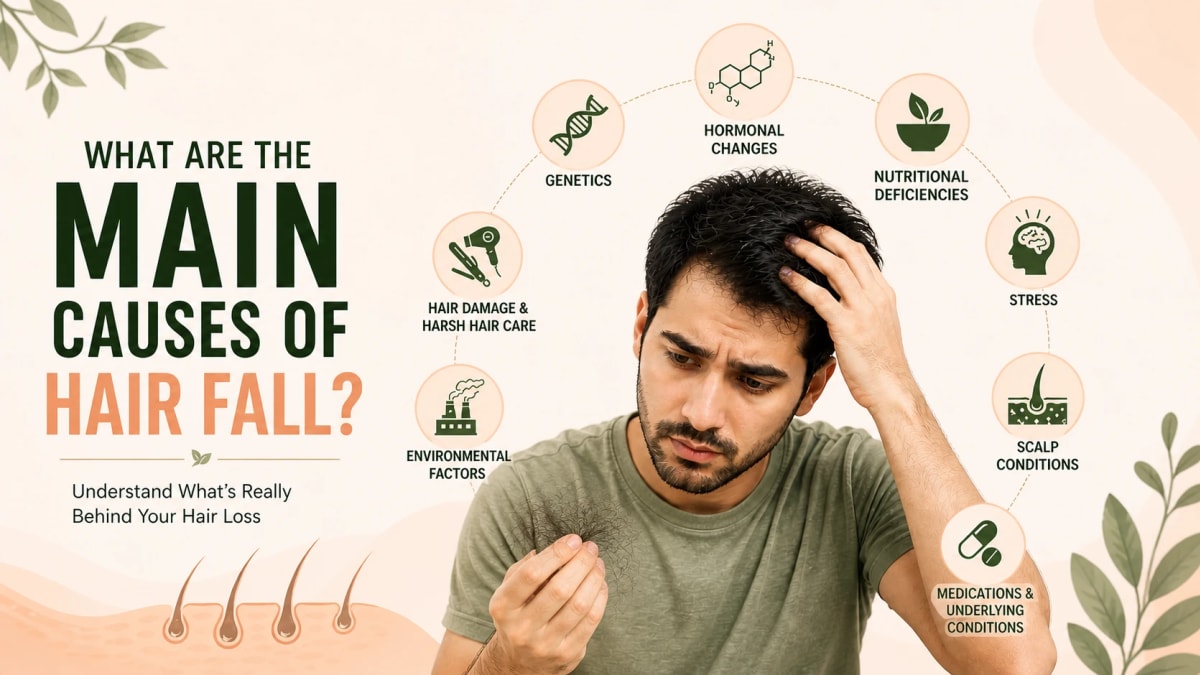
Table of Contents
- It Usually Starts the Same Way
- First, What Is Actually Normal?
- Genetics: The One Most People Don't Want to Hear About
- Hormones Are Running More of This Than You Think
- What You're Eating Or Not Eating
- Stress. Yes, It Really Does This.
- Your Scalp Is Not Just Background
- Medications and Underlying Conditions
- The Damage You're Doing Without Realising It
- Hard Water, Pollution, and the Environment
- Men and Women Don't Lose Hair the Same Way
- So What Do You Do With All of This?
- FAQs
It Usually Starts the Same Way
You notice it in the shower first. A little more hair than usual collecting near the drain. You tell yourself it's fine maybe it's the weather, maybe you haven't washed in a few days, maybe you're imagining it. Then a few weeks later, you're looking at your pillow in the morning and there it is again. And then someone in the family makes an offhand comment. And suddenly you can't un-see it.
This is how it starts for most people. Not with a dramatic bald patch overnight, but with a slow, creeping awareness that something has changed. And the worst part isn't even the hair fall itself it's not knowing why it's happening.
The causes of hair fall are rarely just one thing. That's what makes it so confusing to figure out on your own. It could be something you inherited, something your hormones are doing, something missing from your diet, or honestly a combination of all three at once. This article is an attempt to lay all of that out clearly, so you can stop guessing and actually understand what's going on with your hair.
First, What Is Actually Normal?
Before we get into why hair fall happens, it helps to understand what the hair is doing at any given time.
Every hair on your scalp is at a different stage of a growth cycle. The active growth phase, called the Anagen phase, can last two to six years. After that, the follicle goes through a brief transition before entering the Telogen phase the resting stage where the hair eventually sheds and the follicle starts over.
You have roughly 1,00,000 follicles on your scalp, and at any point, about 10–15% of them are in the resting phase. So losing 50 to 100 hairs a day is completely normal. That's the cycle working as it should.
Hair fall becomes a real concern when significantly more follicles are pushed into the resting and shedding phase at once, when follicles start miniaturising and producing thinner and shorter strands over time, or when follicles simply stop producing hair. The question the one that actually matters is what's causing that to happen.
Genetics: The One Most People Don't Want to Hear About
Let's get this one out of the way early because it's the most common cause of hair loss globally, and it's the one people tend to resist accepting.
Androgenetic Alopecia genetic hair loss accounts for the majority of hair fall cases in both men and women. It's passed down through families, and it works through a hormone called DHT (Dihydrotestosterone), which is a byproduct of testosterone. In people who are genetically sensitive to DHT, the hormone gradually causes the hair follicles to shrink. Each hair that grows comes back thinner and shorter than the last, until the follicle eventually stops producing hair at all.
In men, this tends to follow a recognisable pattern the hairline recedes from the temples, and there's thinning at the crown. In women, it shows up differently: a widening parting, diffuse thinning across the top of the scalp, and a general reduction in volume rather than distinct patches.
A lot of people assume that genetic hair loss only comes from the father's side. That's not accurate. It can be inherited from either parent, and from either side of the family. If you look at relatives on both sides grandfathers, uncles, even maternal relatives and notice a pattern, take it seriously.
Here's the thing about genetic hair loss: it doesn't mean there's nothing you can do. It means you should act early, before more follicles miniaturise beyond the point of return.
Hormones Are Running More of This Than You Think
One of the main reasons why hair fall happens more intensely at certain points in life is hormonal change. And this affects women far more unpredictably than it does men.
Thyroid disorders are a major one. Both an underactive and an overactive thyroid can disrupt the hair growth cycle and cause diffuse shedding across the scalp. The tricky thing is that thyroid-related hair loss looks a lot like other types of hair loss, so it often goes undiagnosed until someone runs a blood panel. If your hair fall has been accompanied by fatigue, weight changes, or changes in body temperature regulation, your thyroid is worth checking.
Postpartum hair loss catches a lot of new mothers completely off guard. During pregnancy, high oestrogen levels essentially hold hair in the growth phase longer than usual which is why many women have noticeably thicker hair during those months. After delivery, oestrogen levels fall sharply, and all those follicles that were being "held back" suddenly shed at the same time. It can look alarming. It is almost always temporary, typically resolving within six to twelve months.
PCOS (Polycystic Ovary Syndrome) raises androgen levels in women, which in turn increases DHT activity. This leads to hair thinning that mirrors male-pattern hair loss at the temples and the top of the scalp. It's one of the more common causes of hair fall in younger women, and it often goes unidentified for years.
What You're Eating Or Not Eating
This one is underestimated. Severely.
Iron deficiency is probably the most prevalent nutritional cause of hair fall in India, particularly among women. Your body needs iron to make haemoglobin, which carries oxygen to every cell including your follicles. When iron (and specifically ferritin, which is the stored form of iron) drops below a certain level, the body begins to prioritise essential organs. Hair follicles are not essential for survival. They're the first to be deprioritised. The shedding usually shows up a few months after the deficiency actually starts, which is part of why it's hard to connect the dots.
Protein deficiency matters too. Hair is made almost entirely of a protein called Keratin. If your daily protein intake is consistently low, the body reduces protein going to hair in favour of more critical functions. This causes follicles to enter the resting phase early. The frustrating thing is that the effect is delayed you're often seeing the result of something that happened two or three months ago.
Vitamin D is one that's getting more research attention now. Low Vitamin D levels have been linked to disrupted hair cycling, and given how common Vitamin D deficiency is in urban India especially among people who spend most of their time indoors this is worth getting tested for. Zinc deficiency can also impair follicle repair. And while Biotin gets a lot of marketing attention, actual Biotin deficiency is quite rare. Most people who take Biotin supplements without a deficiency see very little change in their hair.
Stress. Yes, It Really Does This.
People often roll their eyes at "stress causes hair fall" because it sounds like a vague, catch-all explanation. But the biology behind it is real and specific.
The most direct link is a condition called Telogen Effluvium. When the body goes through significant physical or emotional stress a serious illness, surgery, a period of extreme psychological strain, a major accident, even sudden weight loss it can push a large percentage of hair follicles into the resting phase simultaneously. Two to four months later, you start losing a lot of hair at once. People often can't identify the cause because by the time the shedding starts, the stressful event feels like it's in the past.
Chronic stress is a longer, slower version of this problem. Persistently elevated cortisol disrupts hormonal balance, affects nutrient absorption, and suppresses the hair growth cycle over time. And poor sleep which almost always accompanies chronic stress makes things worse, because hair growth hormones are released during deep sleep.
Your Scalp Is Not Just Background
Healthy hair grows from a healthy scalp. This seems obvious when you say it out loud, but the scalp is probably the most neglected aspect of most people's hair care routines.
Dandruff is more than just a cosmetic inconvenience. It's caused by an overgrowth of a naturally occurring fungus on the scalp, and when left untreated, the resulting inflammation around the follicle can interfere with normal hair growth over time. Seborrheic Dermatitis is a more severe version of the same condition, with redder, greasier, more persistent scaling.
If you want to understand this connection more deeply, read our guide on does dandruff cause hair loss.
Folliculitis infection and inflammation of the hair follicles themselves can cause localised hair loss in patches, and can be bacterial or fungal in origin. Poor scalp circulation is another factor. When blood flow to the scalp is insufficient, follicles don't receive the oxygen and nutrients they need to stay active. This is the real reason behind the advice to massage your scalp it isn't just relaxing; it genuinely increases blood flow to the follicles.
Medications and Underlying Conditions
Some causes of hair loss have nothing to do with your hair directly.
A number of commonly prescribed medications list hair loss as a side effect: certain blood pressure medications, anticoagulants (blood thinners), antidepressants, and chemotherapy drugs are among the more well-known ones. If you've recently started a new medication and noticed increased hair fall, it's worth raising with your doctor sometimes an alternative with fewer follicle-related side effects is available.
Alopecia Areata is an autoimmune condition where the immune system attacks its own hair follicles, causing sudden patches of hair loss. It can range from a few small patches to complete scalp hair loss. It's not caused by anything the person did it's an immune system malfunction.
Diabetes, particularly when poorly managed, can impair the circulation reaching the scalp and create hormonal conditions that accelerate hair thinning. It also increases susceptibility to the scalp infections that compound the problem.
The Damage You're Doing Without Realising It
Some common causes of hair fall are hiding in plain sight in your daily hair routine.
Tight hairstyles ponytails, buns, braids, extensions that put consistent traction on the follicle can cause a condition called Traction Alopecia. The pulling gradually weakens the follicle. Over months and years, this can become permanent hair loss along the hairline and temples. A lot of women who wear their hair pulled back every day for professional reasons don't realise this is happening until the damage is already significant.
Excessive heat straighteners, curling irons, frequent blow-drying on high heat weakens and breaks the hair shaft. Chemically processing hair repeatedly (bleaching, relaxing, perming) without adequate recovery time damages the hair structure and, eventually, the scalp environment. Overwashing strips the scalp of its protective oils. Underwashing lets product residue, excess oil, and dandruff accumulate and obstruct follicles.
None of these things cause dramatic overnight hair loss. They're slow contributors. But they add up.
Hard Water, Pollution, and the Environment
Two things that people rarely consider when trying to understand the common causes of hair fall: the water they wash their hair with, and the air they live in.
Hard water water with a high concentration of calcium and magnesium leaves mineral deposits on the scalp and the hair shaft over time. This buildup weakens the hair structure, makes it more prone to breakage, and can clog follicles. It's a significant issue in many Indian cities. A lot of people notice their hair fall is worse at home than when they travel, and this is often why.
Air pollution particularly fine particulate matter has been shown in research to interfere with the proteins responsible for hair growth and retention. Chronic exposure to polluted air, which is unavoidable in most Indian metros, is increasingly recognised as a contributing factor to accelerated hair thinning.
There's also seasonal shedding, which is real and normal. Many people experience a noticeable uptick in hair fall during autumn roughly September through November. It's a natural fluctuation in the hair cycle and usually self-corrects. But if you don't know it's a recognised pattern, it's easy to panic unnecessarily.
Men and Women Don't Lose Hair the Same Way
They share many of the same root causes genetics, nutrition, stress, hormones but the way hair loss presents is quite different.
In men, genetic hair loss is overwhelmingly the dominant cause. It tends to start in the twenties or thirties and follows a relatively predictable pattern: recession at the temples, thinning at the crown, and gradual progression from there. The earlier it starts, the more aggressive it tends to be.
In women, it's rarely that straightforward. Hormonal fluctuations tied to the menstrual cycle, pregnancy, postpartum changes, PCOS, and the transition into menopause all create a shifting, dynamic picture. Women are also statistically more likely to have nutritional deficiencies particularly iron and Vitamin D that layer on top of other causes.
Women's hair loss almost always presents as diffuse thinning rather than defined patches or a receding hairline, which makes it harder to notice until more significant thinning has occurred.
So What Do You Do With All of This?
Understanding the causes of hair loss is genuinely useful but only if it leads somewhere.
Most causes of hair fall are addressable once correctly identified. Nutritional deficiencies respond to targeted dietary changes and supplementation. Hormonal imbalances require proper medical evaluation and treatment. Stress-related shedding improves when the stressor is addressed and the body is given time to recover. Scalp conditions can be treated with the right products and care. And genetic hair loss, while it can't be "cured," can be significantly slowed and in many cases reversed to a meaningful degree with clinically validated treatments, especially when started early.
The single most common mistake people make with hair fall is waiting. Waiting to see if it stops on its own. Waiting until it's "bad enough" to do something about. Hair follicles don't stay dormant indefinitely. The window for reactivating a follicle and restoring density closes over time. Acting early, with the right information and the right approach, is almost always more effective than any intervention started later.
FAQs
Androgenetic Alopecia genetic hair loss is the most widespread cause of hair fall, both in India and globally. However, nutritional deficiencies, particularly iron and Vitamin D, are also extremely prevalent in the Indian population and frequently contribute to or accelerate hair thinning. In many cases, people are dealing with both simultaneously, which is why identifying the specific cause through a proper assessment matters so much before starting any treatment.
Sudden, excessive shedding is most often a condition called Telogen Effluvium where a significant stressor pushes a large number of follicles into the shedding phase at the same time. The stressor could be a serious illness, surgery, rapid weight loss, a traumatic event, or even prolonged nutritional deficiency. The shedding usually starts two to four months after the triggering event, which is why the connection is often hard to identify. In most cases, Telogen Effluvium is temporary and resolves once the underlying cause is addressed.
Yes and the mechanism is well understood, not just anecdotal. Both acute physical stress and chronic emotional stress can disrupt the hair growth cycle in documented ways. The good news is that stress-related hair fall is largely reversible. Once the stressor is managed, most people begin to see the shedding slow down within a few months, and regrowth typically follows after that. Chronic stress is more complicated, but addressing sleep, cortisol levels, and lifestyle factors consistently leads to improvement over time.
The most impactful deficiencies are iron (specifically low ferritin), Vitamin D, protein, and zinc. A standard blood panel can check for most of these. It's worth noting that the effects of nutritional deficiency on hair are delayed you're usually seeing the result of a deficiency that started two to three months prior. Correcting deficiencies through diet and, where necessary, targeted supplementation typically leads to noticeable improvement in hair fall over three to six months. Self-prescribing supplements without knowing your levels is not recommended some nutrients are harmful in excess.
If you've been experiencing consistent hair fall for more than two to three months, if your parting has visibly widened, if you can see your scalp more easily than before, or if patches are developing don't wait. Hair follicles have a window of opportunity for reactivation, and it's not indefinite. A proper hair assessment one that looks at your pattern of loss, scalp health, lifestyle, and health history gives you a real picture of what's happening and what can be done about it. The earlier you get that picture, the more options you have.