
Does Dry Scalp Cause Hair Loss?
April 27, 2026
·
15 min read
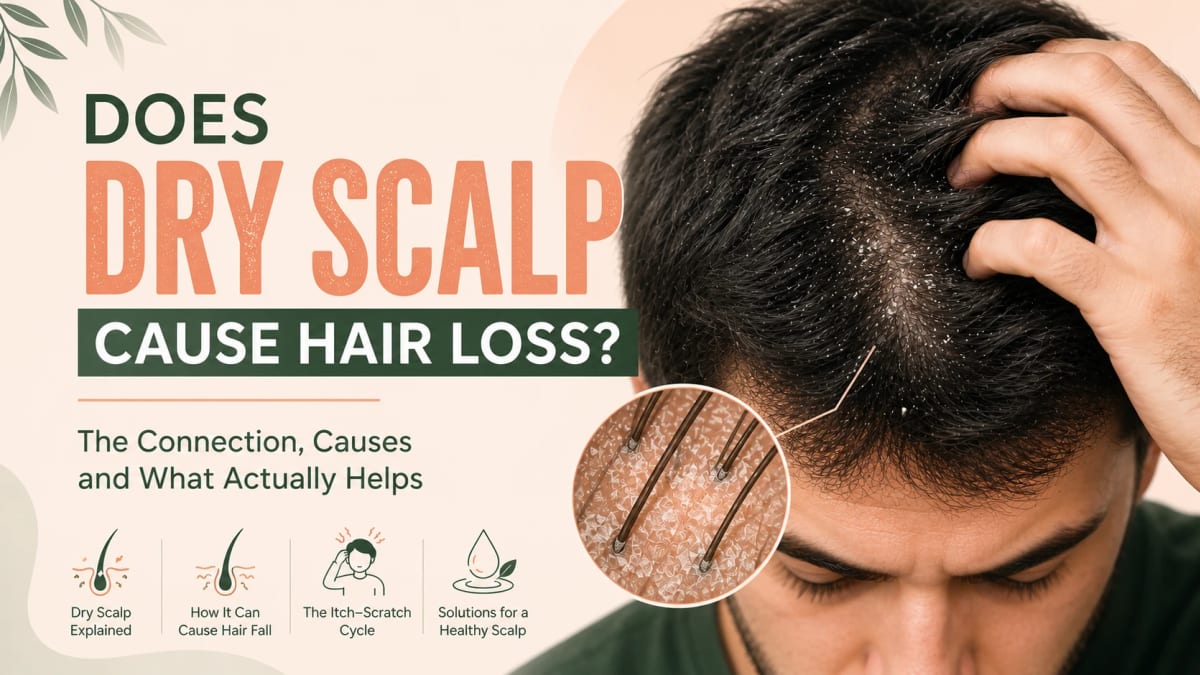
Table of Contents
- The Worry That Starts in the Shower
- First, What Is a Dry Scalp Actually Doing?
- So Does Dry Scalp Cause Hair Loss?
- The Indirect Ways Dry Scalp Contributes to Hair Fall
- When the Scratching Does More Damage Than the Dryness
- Dry Scalp or Something Else? Conditions That Look Similar
- What Is Actually Causing Your Dry Scalp?
- How Dry Scalp Hair Loss Looks Different From Other Types
- The Shared Triggers Nobody Mentions
- What Actually Helps a Dry Scalp
- What to Avoid If Your Scalp Is Dry
- Conclusion
- FAQs
The Worry That Starts in the Shower
You've had a flaky, itchy scalp for a while. Maybe you assumed it was dandruff and used whatever anti-dandruff shampoo was within reach. Maybe it helped a little, maybe it didn't, but you carried on. Then at some point you start noticing something else more hair than usual collecting on your comb, more strands on your pillow in the morning, a parting that looks slightly wider than it did a year ago.
And the question surfaces, quietly at first and then more insistently: is my dry scalp doing this? Is the dryness causing me to lose hair?
It's a fair question. And it's one that deserves a real answer rather than the vague, hedged non-responses that most articles settle for. Because the relationship between dry scalp and hair loss is genuinely nuanced it's not a flat yes or no and understanding it properly changes how you approach both problems.
First, What Is a Dry Scalp Actually Doing?
Before getting into whether dry scalp causes hair loss, it helps to understand what's actually happening on the scalp when it's dry.
The scalp, like all skin, has a protective moisture barrier a thin layer of natural oils, lipids, and water that keeps the skin hydrated, flexible, and resistant to irritation. When this barrier is intact and functioning well, the scalp sheds dead skin cells slowly and invisibly. When it's compromised either because the scalp isn't producing enough natural oil, or because something is stripping the moisture away the barrier breaks down.
Without adequate moisture, the scalp becomes tight, sensitive, and irritated. It starts shedding skin cells faster and in larger, more visible clusters the small white flakes associated with dry scalp. The skin surface cracks microscopically, making the scalp more vulnerable to irritants, allergens, and in some cases, infection.
The follicles sit within this scalp environment. They don't exist in isolation. When the skin around them is compromised and dry, it affects the conditions the follicle is working in and over time, that matters.
So Does Dry Scalp Cause Hair Loss?
Here's the honest answer: dry scalp does not directly destroy hair follicles or shut down hair growth the way some other conditions do. It is not, at its core, a follicle-attacking problem the way Androgenetic Alopecia or Alopecia Areata are.
But and this is the part worth understanding carefully can dry scalp cause hair loss? Yes, it can. Indirectly, cumulatively, and in ways that are easy to miss until the thinning is already noticeable.
The distinction matters because it affects treatment. If someone assumes their hair loss has nothing to do with their dry scalp and ignores the scalp condition entirely, they're leaving a contributing factor unaddressed. On the other hand, if someone assumes their dry scalp is the sole cause of significant hair thinning, they might fix the scalp and still not resolve the hair loss because there are other things driving it that haven't been identified.
Dry scalp hair loss is real. It's just rarely the complete picture on its own.
The Indirect Ways Dry Scalp Contributes to Hair Fall
Let's get specific about the mechanisms because the how is what makes this actionable.
A compromised scalp barrier affects follicle health. The hair follicle is surrounded by scalp tissue, and it relies on a healthy, well-functioning skin environment to operate properly. When the scalp is chronically dry and the barrier is persistently compromised, the follicle is working in suboptimal conditions. Blood circulation in dry, tight skin tends to be reduced compared to healthy, supple skin. Reduced circulation means the follicle receives less oxygen and fewer nutrients through the blood supply. Over time, this contributes to weaker, thinner hair strands not dramatic shedding, but a slow, quiet reduction in hair quality and density.
Chronic dryness creates low-grade inflammation. This is the one most people don't expect. Dry, cracked scalp skin triggers a mild but persistent inflammatory response as the body attempts to repair the compromised barrier. Inflammation around the hair follicle even low-grade, subclinical inflammation interferes with the hair growth cycle. Follicles exposed to chronic inflammatory signals can be pushed into the resting phase earlier than they should be. This doesn't happen overnight. It happens gradually, over months and years, which is why people often don't connect a longstanding dry scalp condition with the hair thinning they notice later.
A dry scalp is more vulnerable to secondary conditions. When the skin barrier is broken down, the scalp becomes easier to colonise by bacteria and fungi. A dry, cracked scalp can develop secondary infections folliculitis being one of the more common ones that directly damage the follicle. The dryness itself might be relatively minor, but the door it opens to more serious scalp conditions is not.
None of these are instant, dramatic hair loss scenarios. They build quietly. And that's exactly what makes dry scalp hair loss easy to underestimate until you're already dealing with more significant thinning than you expected.
When the Scratching Does More Damage Than the Dryness
Dry scalp itches. That's almost universal. And when something itches persistently, people scratch often without thinking about it, while working, watching TV, or lying in bed at night.
This is where a significant portion of the actual follicle damage from dry scalp happens.
Repeated scratching on an already sensitised, dry scalp does a few things that directly affect hair fall:
- It causes mechanical trauma to the follicle. The physical force of scratching disrupts the follicle and can dislodge hairs that are in the early resting phase hairs that would have stayed attached for longer under normal circumstances.
- It breaks the already-fragile scalp surface further, creating micro-abrasions that worsen inflammation and invite infection.
- It damages the hair shaft itself. Repeated friction from fingernails on hair causes breakage near the root that gets counted as hair fall even though the follicle itself is intact.
People who scratch their scalp habitually especially along the hairline and temples, where the itch from dry scalp tends to concentrate often develop localised thinning in those exact areas. They attribute it to stress, or assume it's genetic, without ever making the connection to years of daily scalp scratching.
The itch-scratch cycle with dry scalp is a genuine contributor to hair fall. And it's almost entirely avoidable once the underlying dryness is properly addressed.
Dry Scalp or Something Else? Conditions That Look Similar
This is worth taking seriously, because several scalp conditions produce flaking and itching that gets written off as simple dryness and some of them carry a much more direct hair loss risk.
Scalp Psoriasis is an autoimmune condition that causes thick, silvery-white plaques to form on the scalp. It flakes heavily, itches, and is frequently mistaken for dry scalp. But Psoriasis involves a more aggressive immune response and significantly more inflammation around the follicle. Untreated Psoriasis on the scalp has a stronger association with hair fall than plain dry scalp does, and it requires prescription-level treatment not moisturising shampoos.
Eczema (Atopic Dermatitis) on the scalp presents as dry, red, intensely itchy patches. It's a chronic inflammatory skin condition, and the inflammation it creates around the follicle is more severe than the mild barrier disruption of ordinary dry scalp. People with scalp Eczema often scratch more intensely, which compounds the follicle damage.
Contact Dermatitis a reaction to a specific ingredient in a shampoo, conditioner, hair dye, or styling product can produce sudden dryness, flaking, and inflammation that looks like general dry scalp but is actually an allergic or irritant reaction. If your scalp condition appeared or worsened after introducing a new product, this is worth considering.
Tinea Capitis a fungal infection of the scalp is more common in children but can affect adults. It can cause scaly, dry-looking patches alongside patchy hair loss, and is sometimes misread as dry scalp. Unlike ordinary dry scalp, Tinea Capitis requires antifungal treatment and can cause scarring if left unaddressed.
The reason this matters is simple: if you're treating a more serious scalp condition as if it's ordinary dry scalp, you're not giving it what it actually needs. And conditions that look like dry scalp but carry a higher follicle risk will continue doing damage while you apply coconut oil and hope for the best.
What Is Actually Causing Your Dry Scalp?
Identifying the cause of dry scalp isn't just academic it points directly to how you fix it.
Harsh hair care products are the most common culprit. Shampoos with aggressive sulphates sodium lauryl sulphate in particular are highly effective at removing dirt and oil, so effective that they also strip the scalp's natural moisture barrier in the process. Many mainstream shampoos fall into this category. If you've been using a strongly lathering shampoo your whole life and have always had a somewhat dry scalp, the product is a likely contributor.
Hot water. Washing hair with very hot water is a habit that consistently worsens scalp dryness. Hot water opens up the scalp's pores and strips sebum more aggressively than lukewarm water does.
Cold or dry weather. Low humidity whether from winter air or from spending long hours in air-conditioned spaces pulls moisture out of the scalp the same way it dries skin on the rest of the body.
Overwashing. Washing hair daily removes the natural oils the scalp produces to keep itself moisturised before they have a chance to do their job.
Age. Sebaceous glands produce less oil as we get older. Scalp dryness that develops gradually through the thirties, forties, and beyond is often partly age-related.
Nutritional deficiencies. Low levels of essential fatty acids, Vitamin E, and Vitamin A are all associated with dry, flaky skin including on the scalp.
Underlying skin conditions. Eczema, Psoriasis, and other chronic inflammatory skin conditions frequently affect the scalp and should be identified and treated as the specific conditions they are.
How Dry Scalp Hair Loss Looks Different From Other Types
Hair loss from dry scalp tends to be diffuse spread across the scalp without a defined pattern. You're not losing a concentrated patch in one spot or following a classic receding hairline. It's more of a general reduction in volume and density, often accompanied by hair that feels weaker or more prone to breakage than it used to.
You'll typically notice more breakage than root-level shedding hairs that snap along the shaft rather than pulling out from the follicle with a white bulb at the end. This is because dry scalp makes the hair shaft more brittle and the scalp surface more prone to mechanical damage.
The timing often correlates clearly with the severity of the scalp condition more hair fall during periods when the scalp is at its driest and most irritated, improvement when the scalp is better managed.
Compare this with genetic hair loss, which follows a defined pattern regardless of scalp condition, or with Telogen Effluvium, which produces sudden large-volume shedding after a specific triggering event. Dry scalp hair loss is slower, more diffuse, and more directly tied to what's happening on the scalp surface.
The Shared Triggers Nobody Mentions
Dry scalp and hair loss often have overlapping triggers that make them appear together and make each other worse simultaneously.
Chronic stress is the biggest one. Stress worsens dry scalp by disrupting the skin barrier function and affecting sebum regulation. It worsens hair loss by pushing follicles into the resting phase through Telogen Effluvium and disrupting hormonal balance.
Nutritional deficiencies work the same way. Low iron affects hair growth directly but also affects skin and scalp health. Low Vitamin D has been linked to both compromised skin barrier function and disrupted hair cycling. Low zinc affects follicle repair and scalp regeneration at the same time.
Hormonal changes particularly those associated with thyroid dysfunction, perimenopause, and postpartum recovery affect both scalp oiliness and hair growth cycle simultaneously.
This is why treating the scalp condition in isolation, without looking at the broader picture, often produces results that feel incomplete.
What Actually Helps a Dry Scalp
Get these right and most people see meaningful improvement within three to four weeks.
Switch to a gentle, sulphate-free shampoo
This is the single most impactful change for most people with dry scalp. Look for shampoos that list mild surfactants sodium lauryl glucoside, cocamidopropyl betaine rather than sodium lauryl sulphate or sodium laureth sulphate.
Wash with lukewarm water, not hot
This one is simple, completely free, and makes a real difference. Cool to lukewarm water preserves the scalp's natural oils during washing.
Reduce washing frequency if you're overwashing
For most people with dry scalps, washing every two to three days rather than daily gives the scalp time to rebuild its moisture balance between washes.
Use a scalp oil treatment before washing
Light oils jojoba, sweet almond, argan applied to the scalp thirty to sixty minutes before shampooing help replenish the scalp's lipid layer.
Look at your diet
Increase your intake of healthy fats nuts, seeds, avocado, oily fish. These provide the essential fatty acids that the skin barrier is made from.
What to Avoid If Your Scalp Is Dry
Medicated anti-dandruff shampoos used regularly
If the problem is dry scalp, not dandruff, anti-dandruff shampoos will strip the scalp further. Selenium sulphide and ketoconazole formulas are designed for oily, fungal conditions.
Alcohol-based styling products applied to the scalp
Hair sprays, gels, and some dry shampoos contain alcohol, which is dehydrating.
Skipping conditioner or using it only on hair ends
For dry scalp, a very light conditioner or a scalp-specific moisturising product used closer to the roots helps maintain moisture balance.
Very frequent heat styling directly at the scalp
Blow dryers on high heat held close to the scalp speed up moisture evaporation significantly.
Conclusion
So, can dry scalp cause hair loss? Yes, Not always dramatically, not always as the only cause, but real enough to matter and worth taking seriously.
The relationship between dry scalp and hair loss is indirect but consistent. A chronically dry, compromised scalp creates conditions where hair fall becomes more likely through low-grade inflammation, reduced follicle nourishment, barrier vulnerability to secondary infection, and the mechanical damage caused by persistent scratching.
The good news is that dry scalp responds well to the right care. Unlike genetic hair loss, which requires ongoing clinical treatment, dry scalp is a condition where the right products and habits can produce real improvement within weeks.
And if you've been managing what you assumed was dry scalp for a long time without much improvement, it may be worth getting a proper assessment. Because sometimes what looks like dry scalp is something else entirely and knowing which one you're actually dealing with is the only way to treat it correctly.
FAQs
In most cases, no. Dry scalp hair loss is generally not permanent because it does not destroy the follicle the way some other conditions do. Once the scalp’s moisture balance is restored and the underlying dryness is properly managed, hair fall usually reduces over the following months.
Some additional shedding during periods of scalp dryness and irritation is expected. The baseline normal is around 50 to 100 hairs per day. Anything consistently above this warrants attention.
Pure dry scalp typically does not cause patchy hair loss. It tends to produce diffuse, generalised thinning rather than defined bald spots. Patchy hair loss alongside scalp symptoms is more likely to point toward Alopecia Areata, Tinea Capitis, or Psoriasis.
Switch to a sulphate-free shampoo, wash with lukewarm water instead of hot, reduce washing frequency if you have been washing daily, and introduce a light scalp oil treatment before washing. Most people notice scalp improvement within two to four weeks.
If you have made the right changes to your scalp care routine and the dryness persists beyond six to eight weeks, if the flaking is accompanied by significant redness or thick plaques, if the hair loss continues or worsens despite the scalp improving, or if patchy hair loss is developing, get a proper assessment.