
Does Lack of Sleep Cause Hair Loss? How Better Sleep Supports Healthy Hair
July 30, 2026
·
24 min read
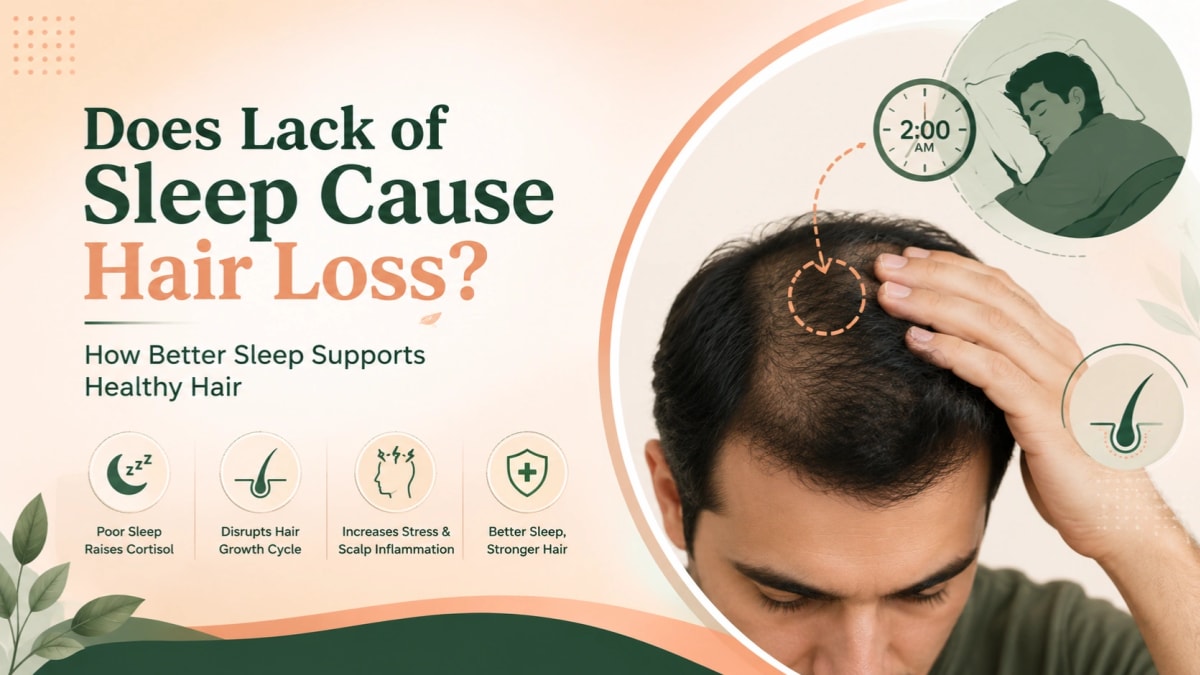
Table of Contents
- The 2 AM Habit That's Showing Up in Your Hair
- What the Body Is Actually Doing While You Sleep
- Does Lack of Sleep Cause Hair Loss?
- The Cortisol Connection: How Poor Sleep Disrupts the Hair Cycle
- Growth Hormone and Hair: The Night Shift Nobody Talks About
- How Sleep Deprivation Affects Scalp Health Specifically
- The Immune System Link Between Poor Sleep and Hair Loss
- Lack of Sleep Hair Fall: What the Pattern Looks Like
- Can Lack of Sleep Cause Hair Loss Permanently?
- How Much Sleep Does Hair Actually Need?
- When Poor Sleep Is Not the Only Problem
- How to Improve Sleep Quality for Better Hair Health
- The Sleep-Hair Connection Nobody Is Managing
- Conclusion
- FAQs
The 2 AM Habit That's Showing Up in Your Hair
Most people who aren't sleeping enough know they aren't sleeping enough. The evidence is hard to miss the tiredness that coffee doesn't fully fix, the brain that feels slightly slower than it should, the mood that sits a few degrees below baseline for days at a time. People know they should sleep more. They just don't, for a hundred reasons that feel very legitimate at eleven at night and somewhat less so at six in the morning.
What most of those people don't know is that the same sleep deprivation that's affecting their energy, concentration, and mood is also doing something specific to their hair.
Not dramatically. Not immediately. But consistently, in the background, through biological mechanisms that connect the quality and duration of sleep directly to the health of the hair follicle and that show up, months later, as increased hair fall that seems to have no obvious cause.
The connection between poor sleep and hair loss is real, it's specific, and it's almost never discussed in the context of hair care. People investigate their diet, their stress levels, their shampoo, their water quality and then keep staying up until two in the morning scrolling, working, or watching something, without ever considering that the hours they're cutting from sleep are cutting something from their hair as well.
What the Body Is Actually Doing While You Sleep
Before getting into why poor sleep affects hair, it helps to understand what sleep is actually for because it's not just rest in the passive sense. Sleep is an active, biologically intensive period during which the body does things it cannot do as effectively while awake.
During sleep particularly during deep sleep (slow-wave sleep) and REM sleep the body releases the majority of its daily growth hormone, undertakes cellular repair and DNA maintenance across tissues, regulates immune function, processes and consolidates metabolic waste, and rebalances hormone levels that were dysregulated during the waking day.
These are not background processes that happen regardless of sleep duration and quality. They are specifically tied to sleep architecture the sequence and depth of sleep stages that only occur in their proper form during adequate, uninterrupted sleep. An adult who sleeps five hours instead of seven or eight doesn't just get less of these processes proportionally. They get significantly less, because the deeper, more restorative sleep stages are the ones that tend to be compressed or eliminated first when sleep is cut short.
The hair follicle is one of the most rapidly dividing cellular structures in the body. It requires cellular repair, hormone regulation, and adequate growth factor activity to maintain its growth cycle properly. All of these are fundamentally sleep-dependent processes. When sleep is consistently inadequate, the follicle's biological environment degrades in ways that are slow, subtle, and directly linked to the quality of sleep the body is and isn't getting.
Does Lack of Sleep Cause Hair Loss?
Yes through several specific, well-understood biological mechanisms. Not in the way a physical stressor like illness or surgery causes sudden dramatic shedding. And not as the sole cause of hair loss in most people experiencing it. But as a real, consistent contributor to the hair fall that builds quietly across months of inadequate sleep.
Lack of sleep hair fall is not a dramatic overnight event. It's the kind of shedding that creeps up on you the hair fall that was maybe 60 hairs a day becomes 90, then 110, and you're not sure when exactly it changed or what's behind it. Sleep deprivation rarely acts alone in producing this picture. It almost always compounds with other factors stress, nutritional gaps, scalp conditions. But removing it from the equation, or dismissing it as unrelated to the hair fall, leaves a meaningful driver unaddressed.
The answer to "does lack of sleep cause hair loss" is yes specifically through elevated cortisol, disrupted growth hormone release, impaired immune regulation, and the downstream effects these have on the hair growth cycle and scalp health. Understanding each mechanism makes the connection concrete rather than vague.
The Cortisol Connection: How Poor Sleep Disrupts the Hair Cycle
This is the most direct and most well-documented pathway between poor sleep and hair loss, and it starts with a hormone most people associate with stress rather than sleep.
Cortisol is the body's primary stress hormone, produced by the adrenal glands and regulated by the hypothalamic-pituitary-adrenal (HPA) axis. In healthy sleep, cortisol follows a clear daily rhythm it is low during the night and early sleep, reaches its minimum around midnight, and then begins rising in the early morning hours to prepare the body for waking. This low-cortisol window during sleep is not incidental. It's when the body's repair and growth processes operate most effectively, because cortisol suppresses many of these processes when it's elevated.
Sleep deprivation breaks this rhythm. When sleep is cut short, irregular, or frequently interrupted, the cortisol minimum that should occur during deep sleep is reduced or eliminated. The body carries elevated cortisol through what should be its restoration window. And chronically elevated cortisol has specific, documented effects on the hair follicle.
Elevated cortisol suppresses the Wnt signalling pathway a molecular signalling system that plays a critical role in initiating and maintaining the Anagen (active growth) phase of the hair cycle. When Wnt signalling is suppressed by sustained cortisol elevation, follicles have more difficulty entering and maintaining the growth phase. They spend more time in the Telogen (resting) phase and transition to shedding more readily.
Cortisol also degrades the extracellular matrix of the hair follicle the connective tissue scaffold that supports the follicle's structure and anchoring in the dermis. This degradation weakens the follicle's foundation, reduces its resilience to other stressors, and contributes to the miniaturisation of the follicle over time.
And here is where the poor sleep and hair loss connection becomes circular in a damaging way: stress increases cortisol, which disrupts sleep, which elevates cortisol further, which worsens hair loss, which causes more stress about the hair loss. People experiencing this cycle often cannot identify which came first the stress, the sleep disruption, or the hair fall because by the time they're aware of the problem, all three are feeding each other simultaneously.
Growth Hormone and Hair: The Night Shift Nobody Talks About
This mechanism is less well-known than the cortisol connection, but it's equally important for understanding why sleep quality matters specifically not just sleep duration.
Human Growth Hormone (HGH) is released in pulses, with the largest and most significant pulse occurring during the first episode of deep slow-wave sleep typically one to two hours after falling asleep. This is not a small amount. Approximately seventy to eighty percent of daily growth hormone is released during this single deep sleep window.
Growth hormone plays a direct role in hair follicle health. It stimulates IGF-1 (Insulin-like Growth Factor 1) production in tissues throughout the body, including the scalp, and IGF-1 is a known promoter of the Anagen growth phase in hair follicles. Research has shown that IGF-1 signalling encourages follicles to enter and sustain the growth phase, and that reduced IGF-1 activity is associated with follicles spending more time in the resting and shedding phases.
When sleep is consistently poor specifically when deep slow-wave sleep is disrupted or eliminated the primary growth hormone pulse is diminished or absent. The IGF-1 signalling downstream from that pulse is correspondingly reduced. The follicles that depend on this IGF-1 environment to maintain robust Anagen phase activity don't receive the signal they need, and hair growth progressively weakens.
This is why sleep quality matters as much as sleep quantity for hair health. Someone who sleeps seven hours but wakes frequently from noise, from anxiety, from a phone notification at midnight may have very little deep slow-wave sleep despite the total sleep duration. The growth hormone pulse that depends on reaching and sustaining deep sleep doesn't occur adequately. The hair effect is similar to sleeping five hours straight.
How Sleep Deprivation Affects Scalp Health Specifically
Beyond the hormonal mechanisms, poor sleep has direct effects on the scalp's condition that contribute to the hair fall picture.
Skin barrier function degrades with insufficient sleep. The scalp, like all skin, maintains its barrier the protective lipid layer that keeps moisture in and irritants out through cellular repair processes that occur predominantly during sleep. In people who are consistently under-sleeping, the scalp's barrier is measurably more permeable and more prone to trans-epidermal water loss than in well-rested people. A compromised scalp barrier is a drier, more easily irritated scalp one that is more susceptible to the inflammatory triggers and microbial imbalances that affect follicle health.
Sebum production increases with sleep deprivation. Elevated cortisol from poor sleep stimulates sebaceous gland activity, increasing scalp oiliness. People who notice their scalp becoming greasier during periods of poor sleep are seeing this directly. More scalp oil means a richer environment for Malassezia, increased dandruff risk, and the follicle congestion that accumulates over time into a meaningful contributor to hair fall.
Scalp inflammation increases. Poor sleep is consistently associated with elevated levels of systemic inflammatory markers including interleukins and TNF-alpha that affect tissue throughout the body, including the scalp. Chronic low-grade scalp inflammation, driven partly by the elevated inflammatory markers of sleep deprivation, disrupts the follicle's growth cycle and creates the hostile follicle environment that pushes hairs into the shedding phase prematurely.
Cell turnover and repair slow down. The scalp's skin cells like all skin cells undergo their most active repair and renewal during sleep. Insufficient sleep means a scalp that is accumulating cellular damage faster than it's repairing it. Dead skin cell buildup, follicle congestion, and reduced scalp regeneration all contribute to the environment in which hair fall becomes more likely.
The Immune System Link Between Poor Sleep and Hair Loss
This is a mechanism that connects poor sleep specifically to autoimmune and inflammatory forms of hair loss and it's one worth understanding for people whose hair loss doesn't fit a clear genetic or nutritional pattern.
Sleep is one of the primary regulators of immune function. During sleep, the immune system produces and releases cytokines signalling proteins that regulate immune responses and inflammation. Adequate sleep is required for the immune system to maintain its regulatory balance: the ability to mount appropriate responses to genuine threats while staying appropriately suppressed in the absence of threats.
Chronic sleep deprivation dysregulates this balance. The immune system of a chronically under-slept person is simultaneously less effective at fighting genuine infections and more prone to inflammatory overreaction including misidentifying the body's own tissues as targets.
Alopecia Areata the autoimmune condition in which the immune system attacks hair follicles, causing patchy hair loss has documented associations with sleep disruption. Research has found higher rates of sleep disorders in people with Alopecia Areata, and the relationship appears bidirectional: the immune dysregulation from poor sleep may trigger or worsen autoimmune follicle attacks, and the psychological stress of Alopecia Areata worsens sleep quality.
More broadly, the elevated inflammatory markers of chronic sleep deprivation create an environment in which the follicle is under sustained immune pressure. This doesn't necessarily cause Alopecia Areata but it does create scalp conditions in which inflammatory hair fall is more likely, and in which existing scalp conditions like seborrheic dermatitis become more difficult to manage.
Lack of Sleep Hair Fall: What the Pattern Looks Like
Understanding how sleep-deprivation hair fall presents helps identify whether it's a significant factor in what you're experiencing.
Sleep deprivation hair fall is diffuse it affects the entire scalp rather than following a defined pattern at the temples or crown. You're not developing a receding hairline or a concentrated bald spot. The hair fall is spread evenly, and what you notice first is usually a general reduction in volume and density rather than localised thinning.
It corresponds with periods of poor sleep rather than arriving suddenly from a specific event. People who trace back their hair fall often find it crept up gradually during a period of sustained sleep disruption a demanding work project, a new baby, a period of anxiety or insomnia rather than arriving as a sudden large shed.
It is often accompanied by other signs of sleep deprivation skin that looks duller than usual, slower wound healing, persistent fatigue, more frequent minor illnesses which together suggest that the body's repair processes are generally running below capacity, not just in the hair.
It tends to improve with sleep improvement, though with the characteristic two-to-three-month lag between the biological change and visible shedding reduction. People who address their sleep and notice their hair fall reducing two to three months later often don't connect the two because the lag makes the improvement look unrelated to the intervention.
Can Lack of Sleep Cause Hair Loss Permanently?
In most cases, no and this is the genuinely reassuring aspect of sleep-related hair loss.
The mechanisms through which sleep deprivation affects hair fall cortisol elevation, reduced growth hormone, increased scalp inflammation, impaired barrier function are functional and hormonal rather than structural. They affect how the follicle operates without destroying the follicle itself. When sleep is restored to adequate levels, these mechanisms reverse. Cortisol levels drop. Growth hormone release normalises. Scalp inflammation reduces. The follicle's biological environment improves, and over the following two to three months, the hair cycle begins to reflect that improvement through reduced shedding and improved hair quality.
The exception as with most hair loss causes is when the sleep deprivation has been severe and prolonged enough to compound with other vulnerabilities. Someone whose genetic predisposition to androgenetic alopecia has been significantly accelerated by years of chronic sleep deprivation may have lost ground that doesn't fully recover even after sleep improves, because the genetic follicle miniaturisation that was accelerated has progressed further than it would have otherwise. But this is the extreme scenario, not the typical one.
For most people experiencing sleep-related hair fall, the prognosis with sleep improvement is good. The follicles are intact and viable. They've been operating in a suboptimal environment. Improving that environment allows them to return to normal function.
How Much Sleep Does Hair Actually Need?
This maps closely to how much sleep the body needs generally because the mechanisms through which sleep supports hair health are the same mechanisms through which sleep supports cellular repair, hormone regulation, and immune function overall.
Seven to nine hours per night for adults is the range consistently supported by sleep research, with most people functioning best at the higher end of that range rather than the lower. This is not "recommended" in the sense of an ideal aspiration it's the sleep duration at which the cortisol rhythm, growth hormone pulse, and immune regulation processes that hair depends on actually occur properly.
Below seven hours particularly at six hours or less, sustained over weeks the biological effects on cortisol, growth hormone, and immune regulation become measurable and meaningful. This is the range where lack of sleep hair fall becomes a real contributor rather than a marginal one.
But duration is not the only variable. Sleep quality specifically, the proportion of time spent in deep slow-wave sleep and REM sleep matters as much as total hours. Seven hours of fragmented, interrupted sleep with minimal deep sleep delivers far less growth hormone and far less restoration than seven hours of consolidated, uninterrupted sleep. People who sleep for adequate durations but wake frequently, have sleep apnea, or experience anxiety-driven light sleep may be getting the hours without the biology.
Sleep timing also matters in ways that are underappreciated. The growth hormone pulse tied to deep sleep tends to occur in the first sleep cycle of the night the first ninety minutes of sleep. People who go to bed very late, even if they sleep for seven or eight hours, shift the timing of this cycle later and may reduce its effectiveness. The cortisol minimum that should occur around midnight also shifts with late bedtimes, compressing the low-cortisol restorative window. Sleeping from midnight to eight is not biologically identical to sleeping from ten to six, even for the same total duration.
When Poor Sleep Is Not the Only Problem
This is worth stating clearly because sleep deprivation rarely causes hair loss as a standalone factor, and addressing sleep alone while ignoring other contributors will produce incomplete results.
Poor sleep almost always compounds with other things. It worsens the effect of nutritional deficiencies a person who is mildly iron deficient and sleeping six hours handles the deficiency worse than someone with the same iron level sleeping eight hours, because sleep deprivation impairs the body's efficiency in using the nutrients it does have. It amplifies genetic hair loss the cortisol elevation and DHT-related mechanisms that poor sleep activates hit harder on follicles that are already genetically sensitive to DHT. It worsens existing scalp conditions the inflammation and sebum increase from poor sleep make dandruff and oily scalp conditions more severe.
And stress and poor sleep are so closely intertwined that it's often difficult to separate their contributions. Stress disrupts sleep. Sleep deprivation elevates cortisol, which worsens the stress response. Both drive hair fall through overlapping mechanisms. Addressing one without the other managing stress but not sleep, or improving sleep but not stress produces partial results.
The full picture of someone experiencing sleep-related hair fall usually involves sleep, stress, some nutritional element, and often a scalp condition that all need attention simultaneously. Sleep improvement is one essential component, not the complete solution on its own.
How to Improve Sleep Quality for Better Hair Health
Practical steps that actually move the needle not a generic sleep hygiene checklist, but the interventions with the most direct relevance to the specific sleep biology that hair depends on.
Protect the first ninety minutes of sleep. Since the first deep sleep cycle contains the largest growth hormone pulse, falling asleep quickly and not being disturbed in the first hour and a half of sleep is the most important window to protect. This means the environment matters a dark, cool, quiet room is not optional comfort, it's the condition in which deep sleep happens most readily. Blackout curtains, no phone notifications after a set time, a slightly cooler room temperature than the rest of the day.
Establish a consistent sleep and wake time. The body's cortisol rhythm and the timing of deep sleep stages are regulated by the circadian clock the biological timing system that coordinates body processes with the light-dark cycle. Consistent sleep and wake times strengthen the circadian signal, making it easier to fall into deep sleep quickly and reliably. Irregular sleep timing different bedtimes and wake times across weekdays and weekends disrupts the circadian rhythm and degrades sleep quality even when total hours are adequate.
Reduce cortisol in the evening. The cortisol that needs to be low for deep sleep to occur properly must be dropping through the evening hours. Activities that elevate cortisol in the evening intense exercise late at night, stressful work or news consumption close to bedtime, arguments, high-pressure environments delay and blunt the cortisol drop, making it harder to reach deep sleep quickly. Protecting the two hours before bed from cortisol-elevating activities is a direct investment in the quality of the sleep that follows.
Address sleep-disrupting scalp conditions. An itchy, inflamed scalp that wakes you repeatedly during the night from dandruff, seborrheic dermatitis, or scalp psoriasis creates fragmented sleep that reduces time in deep stages. Managing the scalp condition is, in this specific scenario, simultaneously managing the hair fall and improving sleep quality. Both improve together when the scalp condition is brought under control.
Manage light exposure. Blue light from phones and screens in the evening suppresses melatonin the hormone that signals the body to prepare for sleep delaying the onset of deep sleep and shifting the cortisol minimum later. Reducing screen exposure in the final hour before bed, or using blue-light filtering settings, is not a minor quality-of-life preference. It's a direct modulator of the sleep biology that hair growth depends on.
Consider whether there's an underlying sleep disorder. Sleep apnea characterised by repeated breathing interruptions during sleep is significantly more common than most people realise and is one of the most damaging sleep disruptors for overall health, including hair health. It fragments sleep architecture profoundly, prevents adequate deep sleep, elevates cortisol, and reduces oxygen delivery to tissues including the scalp. People who sleep for eight hours and still feel exhausted, who snore or are told they stop breathing in sleep, or who have a partner who notices their disturbed breathing deserve a proper sleep evaluation. Treating sleep apnea can produce meaningful improvements in hair health alongside the broader health benefits.
The Sleep-Hair Connection Nobody Is Managing
Here is what stands out about the sleep and hair loss relationship compared to most other hair fall causes: it is almost entirely invisible in how people think about and manage their hair.
People change their shampoo when hair falls. They start oiling. They buy supplements. They investigate hard water. They switch to sulphate-free. These are all reasonable responses to specific causes, and for the people whose hair fall has those causes, they help. But very few people even those who know intellectually that sleep affects health sit down with their hair fall and ask seriously: how much am I actually sleeping, and is it enough?
The answer, for a significant proportion of people experiencing unexplained or worsening hair fall, is that they are not sleeping enough and it is contributing. Not as the only cause rarely that. But as a consistent background driver that makes every other cause worse and every other treatment less effective.
Better sleep does not require a product. It does not require a specialist appointment, a prescription, or an expensive intervention. It requires taking the connection seriously enough to actually change the habits that are preventing it. That's a harder change than buying a new shampoo. But for hair health and for everything else the body does during sleep it matters more than most people currently account for.
Conclusion
Does lack of sleep cause hair loss? Yes through elevated cortisol that disrupts the hair growth cycle, through reduced growth hormone that weakens the Anagen phase, through scalp inflammation and degraded barrier function, and through immune dysregulation that creates a hostile environment for the follicle. These are not vague, unsubstantiated connections. They are specific biological mechanisms that link sleep quality and duration directly to follicle health.
Can lack of sleep cause hair loss permanently? Rarely, and not in most scenarios where sleep is the primary driver. The mechanisms are functional and reversible. Restore adequate sleep, and the biological environment the follicle depends on starts to recover within weeks.
Poor sleep and hair loss are connected in a way that is real, specific, and almost entirely unmanaged by most people dealing with hair fall. That's not because the connection isn't real. It's because the connection isn't being made.
The hair needs the body to sleep. Not just for rest for repair, for hormone release, for immune regulation, for cellular renewal. All the things that happen during those seven to nine hours that aren't happening when you stay up until two in the morning. The comb in the morning is just the delayed evidence of what the night before looked like.
FAQs
The biological disruption to the hair cycle from sleep deprivation begins relatively quickly within weeks of sustained insufficient sleep, cortisol elevation and reduced growth hormone start affecting the hair follicle's environment. But the visible hair fall that results from these disruptions typically takes two to three months to become noticeable, because of the lag between follicle disruption and the shedding phase completing. Most people experiencing sleep-related hair fall notice the increase in shedding during or after a prolonged period of poor sleep, not at its beginning. The same lag applies to improvement better sleep shows up in reduced hair fall two to three months after the sleep improves, not immediately.
The effects become meaningful below seven hours per night sustained over weeks. Occasional poor nights one or two a week are unlikely to produce significant hair fall because the body has some resilience and the biological disruption is not sustained long enough to push follicles into a different phase. It's chronic sleep deprivation consistently five to six hours or less that produces the cortisol elevation, growth hormone reduction, and inflammatory changes that translate into real hair fall. Sleep quality disruption from fragmented sleep, even at seven or eight total hours, also matters someone with severe sleep apnea or anxiety-driven wakefulness can be significantly affected despite adequate time in bed.
They can coexist shift workers, new parents, people with medical conditions that disrupt sleep, or those with primary insomnia unrelated to stress all experience sleep deprivation without it being primarily stress-driven. The biological mechanisms cortisol dysregulation, growth hormone reduction, immune changes still operate regardless of whether stress is the cause of the sleep disruption. That said, stress and poor sleep are so frequently intertwined in real life that it's unusual to find one completely absent when the other is present. For the purposes of managing the hair fall, both sleep and stress deserve attention simultaneously regardless of which came first.
Partially, but not fully. Napping can reduce some of the cortisol load from sleep deprivation and provide some restorative benefit. However, the primary growth hormone pulse that hair depends on is specifically tied to the first deep slow-wave sleep episode of the night which follows the body's natural circadian rhythm and does not replicate as effectively during daytime napping. A nap can reduce the damage from a poor night's sleep, but it doesn't provide the same follicle-relevant biological processes that consolidated nighttime sleep does. For hair health specifically, the quality and timing of nighttime sleep matters more than compensatory daytime napping.
The two-to-three-month lag that applies to most hair fall triggers applies here as well. The hair follicles that were pushed toward the shedding phase by sleep deprivation-related cortisol elevation need to complete their telogen phase and shed before new, better-quality growth begins. Improving sleep doesn't stop the shedding of those follicles immediately it changes the environment for the follicles still in the growth phase and for the new growth cycles beginning after the sleep improvement. Most people start noticing a reduction in daily hair fall around eight to twelve weeks after meaningfully improving their sleep, with hair quality thickness, reduced breakage, improved texture following over the months after that.