
Does Wearing a Cap Cause Hair Loss? Everything You Need to Know
July 22, 2026
·
24 min read
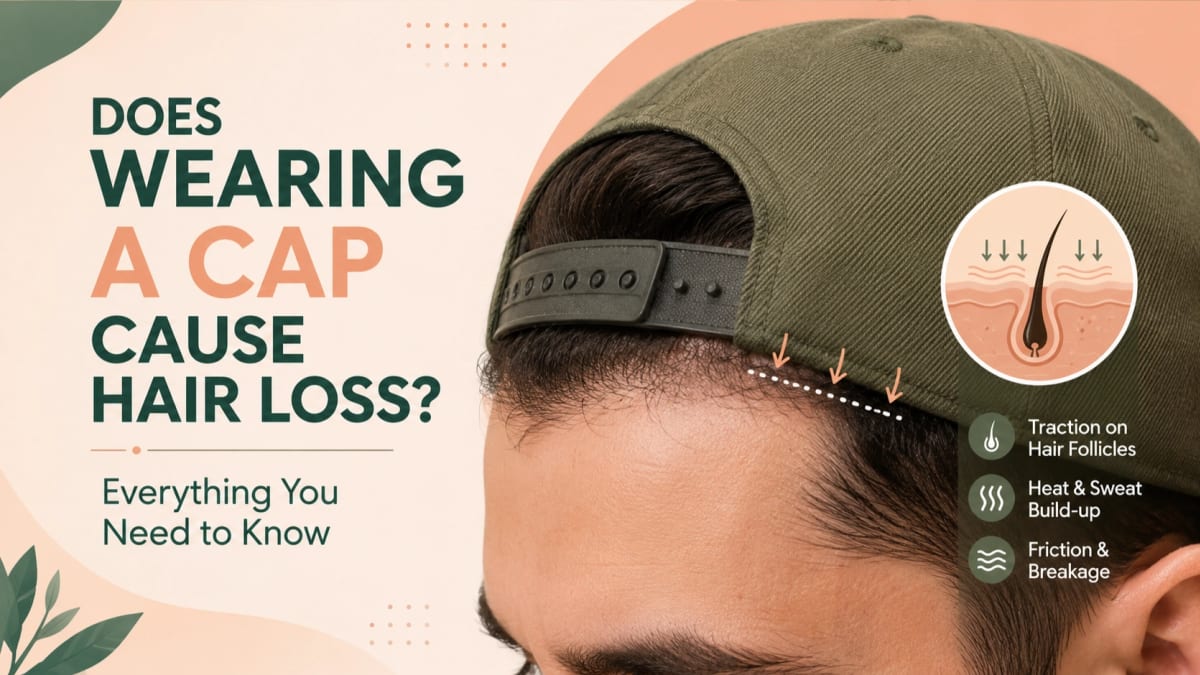
Table of Contents
- The Cap You've Been Wearing Every Day
- What Actually Happens Under a Cap
- Does Wearing a Cap Cause Hair Loss?
- Traction: The Most Direct Way Caps Affect Hair
- The Heat and Sweat Problem Inside a Cap
- Friction and Breakage Along the Cap Edge
- Does Wearing Cap Damage Hair Beyond the Hairline?
- Cap vs Helmet: Is One Worse Than the Other?
- Is Wearing Cap Good for Hair in Any Situation?
- Who Is Most at Risk From Cap-Related Hair Loss?
- How to Tell If Your Hair Loss Is Cap-Related
- How to Wear a Cap Without Damaging Your Hair
- What Doesn't Help
- Conclusion
- FAQs
The Cap You've Been Wearing Every Day
It starts innocuously enough. A cap for the gym in the morning. The same cap pulled on for a quick errand. Then again in the afternoon because the sun is brutal and there's no time to think about it. Before long, the cap is on for six, seven, eight hours a day not because of any particular decision, but because it became the path of least resistance for managing hair, blocking sun, and looking put-together without effort.
For a lot of people particularly men in their twenties and thirties the daily cap is less a style choice and more a hair management tool. And somewhere in the back of their minds, a question sits quietly: is this thing making my hair fall faster?
It's a question that gets dismissed a lot. "Caps don't cause hair loss, that's a myth," goes one camp. "Your cap is definitely why your hairline is receding," goes the other. Both are too simple. The real answer involves understanding what a cap actually does to the scalp and hair when worn daily for extended periods and recognising that the answer is different depending on how the cap fits, how long it's worn, what material it's made of, and what the person's underlying hair situation already looks like.
What Actually Happens Under a Cap
Before getting into whether wearing a cap causes hair loss, it helps to think clearly about the physical environment a cap creates on the scalp.
A cap particularly a fitted cap, a snapback, or a snug beanie sits against the scalp and hair with consistent pressure. It creates a partially enclosed environment that traps heat. Depending on the material, it may or may not allow air circulation to the scalp underneath. During physical activity or in warm weather, sweat accumulates in this enclosed space with nowhere to go. The hat band or edge of the cap presses against the hairline with whatever force the fit applies constantly, for as long as it's worn.
None of this is dramatic in a single session. Wear a cap for an hour and take it off the scalp is none the worse for it. The follicles have experienced some mild mechanical pressure and a slightly elevated local temperature. The hair might be flattened. Nothing concerning has happened.
But wear the same cap for eight hours a day, every day, for months and years and the cumulative picture is different. The scalp that's been under pressure for eight hours experiences something fundamentally different from the scalp that wore a cap for one hour. The follicles that have had the hat band pressing against them daily for a year have been subjected to a sustained mechanical stressor that adds up in ways the individual session doesn't suggest.
This is the core of the cap-and-hair-loss question. It's not about the cap. It's about how the cap is being used.
Does Wearing a Cap Cause Hair Loss?
Yes under specific conditions, and through specific mechanisms. Not because a cap is inherently dangerous, and not because any amount of cap-wearing automatically damages hair. But because daily, extended cap-wearing creates a set of scalp and follicle conditions that contribute to hair fall in ways that are real, documented, and frequently underestimated.
Wearing cap causes hair loss through three primary pathways: traction on the follicle from a tight or ill-fitting cap worn consistently, scalp heat and sweat accumulation in an enclosed cap environment, and friction damage to the hair shaft along the cap edge. The severity of each depends on the specifics of how the cap is worn its fit, its material, how long it's on, and what the scalp underneath it is already dealing with.
A loose, breathable cap worn for a few hours, followed by proper scalp hygiene that's a manageable situation for most scalp types. A tight, synthetic cap worn for eight hours a day without washing, on a scalp that's already oily and prone to dandruff that's a meaningful and progressive hair fall risk.
The distinction matters, because the correct advice isn't "stop wearing caps." It's "understand what your cap-wearing habit is doing to your scalp and adjust accordingly."
Traction: The Most Direct Way Caps Affect Hair
Of the three mechanisms, traction is the most direct and the one with the most significant long-term implications.
Traction Alopecia hair loss caused by sustained, repeated mechanical pulling or pressure on the follicle is a well-described clinical condition. It's most commonly associated with tight hairstyles: high ponytails, braids, cornrows, extensions. But the same mechanism applies to any sustained mechanical force on the follicle, including the consistent pressure of a tight cap sitting against the hairline day after day.
The hat band of a fitted cap or the front edge of a snapback or baseball cap presses against the hairline with a consistent force determined by the cap's fit. A cap that fits correctly applies mild, even pressure distributed across the hairline. A cap that's slightly too small, or a style that's worn pulled down more tightly than its design intends, concentrates that pressure at specific contact points along the hairline.
Here is what repeated, sustained pressure does to the follicle over time. The follicle is anchored in the dermis but is not immune to mechanical stress. Constant directional pressure pressing inward from the hat band, day after day reduces the blood supply to the compressed follicle, creates micro-inflammation at the follicle base, and gradually weakens the follicle's anchoring in the dermal tissue. Initially this shows up as hairs that shed more easily from the hairline particularly along the front edge where the cap presses hardest. The hairline may begin to look slightly less defined, slightly further back than it used to be.
This is traction alopecia in its early, reversible stage. If the source of traction is removed or reduced at this point by wearing the cap more loosely, for shorter periods, or not at all for a while the follicle typically recovers and the hair regrows. But if the daily pressure continues for years without interruption, the follicle eventually develops scar tissue at its base. Scarred follicles cannot produce hair. That hair loss is permanent.
The critical point: early-stage traction alopecia looks mild and feels manageable. It doesn't hurt. The hair fall is gradual. Most people don't take it seriously until the hairline change is visible and obvious by which point some degree of permanent damage may already have occurred.
The Heat and Sweat Problem Inside a Cap
Caps vary significantly in how much heat they trap a thin cotton cap in a cool environment traps very little, a thick acrylic beanie in summer traps an enormous amount but all caps create some degree of enclosed environment on the scalp, and that has consequences.
Heat raises the local temperature of the scalp, which stimulates sebaceous gland activity. The scalp under a cap that's been on for several hours produces more sebum than the same scalp without a cap. More sebum means a richer feeding environment for Malassezia, and more follicle congestion as the excess sebum mixes with dead skin cells and accumulates around the follicle opening.
For someone who already has an oily scalp or existing dandruff, the heat-and-sebum acceleration under a daily cap is a significant worsening factor. The dandruff that was manageable becomes more aggressive. The oiliness that required washing every second day now requires daily washing. And if the washing isn't increased to match the increased scalp activity which often happens because people don't realise the cap is driving the change the Malassezia overgrowth and follicle congestion escalate through the season.
The sweat component compounds this. During exercise, commuting, or simply wearing a cap in warm weather, sweat accumulates on the scalp surface under the cap with limited ability to evaporate. As discussed in the context of helmets and exercise-related hair fall, sweat sitting on the scalp leaves behind salt, lactic acid, and in apocrine sweat, androgen byproducts including precursors that can be converted to DHT at the scalp surface. A cap that traps this sweat against the scalp for hours creates the same chemical environment as post-workout sweat sitting on the scalp just more slowly and less dramatically.
The cap's material determines how much of this is happening. A tightly woven synthetic cap traps heat and moisture very effectively, creating the most aggressive enclosed environment. A loosely woven cotton cap allows far more air circulation and moisture escape. Wool and wool blends sit between the two. The material choice is one of the simplest and most impactful variables in cap-related hair fall risk.
Friction and Breakage Along the Cap Edge
The third mechanism is less about the follicle and more about the hair shaft but it shows up as hair fall and contributes to the overall thinning picture.
Every time a cap is put on and taken off, the inner band or lining of the cap drags across the hair strands at the contact zone typically the hairline, temples, and sides. This creates friction on the hair shaft. On a single occasion, this friction is trivial. But repeated daily across months and years, it roughens the cuticle of the hairs that sit in the contact zone, weakens the shaft, and causes breakage at or near the root level.
The breakage pattern from cap friction is characteristic: shorter, stubbly hairs at the hairline that snap off rather than shedding from the root. The hair in the affected zone is always shorter than the hair further back on the scalp because it keeps breaking at the point of friction contact before it can grow to a full length. People often interpret this as the hairline "not growing" when the hair is actually growing but being repeatedly broken off.
The roughness of the cap's inner material matters significantly here. A cap with a rough canvas or thick foam inner band creates more friction than one with a smooth fabric lining. Caps that have become stiff or misshapen with wear create irregular friction patterns that are worse than a cap in good condition.
Hair that is already dry or damaged from sun, heat styling, or chemical treatment is more prone to this friction breakage than healthy, moisturised hair. Applying a light conditioner or hair serum to the hairline area before wearing a cap reduces friction damage meaningfully.
Does Wearing Cap Damage Hair Beyond the Hairline?
The mechanisms described so far traction, heat, sweat, friction are most concentrated at the cap's contact zone: the hairline, temples, and sides. But does cap-wearing damage the hair and scalp across the entire covered area?
The heat trapping and sweat accumulation effects apply to the entire scalp under the cap, not just the edges. An oily scalp worsened by daily cap-wearing shows the effects across the full scalp surface, not only at the hairline. Malassezia growth accelerated by the warm, enclosed cap environment affects the entire covered scalp.
For the hair shaft specifically, friction damage is concentrated where the cap makes physical contact primarily the edges. The hair in the centre of the scalp, if it's not in contact with the cap lining, doesn't experience the same cuticle-roughening friction. However, the heat and moisture trapped under the cap does raise the cuticle mildly through a temperature effect similar to though milder than hot water washing, which means the hair under the cap is in a slightly more vulnerable state than hair exposed to open air.
The concentrated damage at the hairline is what becomes visually apparent first the receding or thinning hairline. But the generalised scalp health impact of daily cap-wearing affects hair quality across the covered area over time, even if the structural follicle damage from traction is localised.
Cap vs Helmet: Is One Worse Than the Other?
A fair question given the overlap in mechanisms, and the answer has some nuance.
Helmets are generally more damaging than caps for hair and scalp health, for a few specific reasons. The fit of a helmet is intentionally tighter than a cap that's a safety feature, not a style choice. The enclosed environment of a helmet is more sealed, trapping more heat and sweat than a cap does. The weight of a helmet creates more downward pressure on the scalp than a lightweight cap. And the duration of daily helmet wearing for a commuter is often longer than cap-wearing two to four hours versus the variable wearing time of a cap.
That said, caps can approach helmet-level impact in some scenarios. A very tight cap worn for eight or more hours daily creates sustained traction that exceeds what a well-fitted helmet worn for two hours produces. A thick beanie worn year-round traps more heat than a ventilated helmet. And caps are often worn without the scalp hygiene awareness that helmet-wearing has begun to generate people know to rinse after a sweaty commute, but fewer people think to do the same after a day of cap-wearing.
The practical takeaway: helmets are the more severe risk per hour worn, but caps can produce comparable cumulative damage simply by being worn for more hours per day with less intentional management.
Is Wearing Cap Good for Hair in Any Situation?
Yes and this is worth saying clearly because the cap-and-hair-loss conversation can veer into the impression that caps are universally bad for hair. They're not.
A cap worn outdoors provides genuine UV protection to both the scalp and the hair shaft. This is significant. As discussed in the sun damage context, UV radiation degrades the hair shaft's protein structure, depletes melanin, and creates oxidative stress at the follicle level. A cap that covers the scalp and the upper hair blocks a meaningful portion of this UV load. For someone spending extended time outdoors at a cricket match, on a construction site, commuting on a two-wheeler a cap is actively protecting the scalp and hair from UV damage that would otherwise accumulate.
A cap worn in cold weather protects the scalp from the wind and cold that accelerate moisture loss from both the scalp surface and the hair shaft. In genuinely cold environments, covering the head maintains scalp temperature and reduces the dryness and irritation that cold wind exposure causes.
A cap can also protect the hair from particulate pollution the airborne dust and particulate matter that deposits on hair and scalp in urban environments. Covered hair accumulates less of this environmental load between washes.
So is wearing cap good for hair in the right circumstances? Yes. The UV and cold-weather protection benefits are real. The problem is not the cap. The problem is a cap worn too tightly, for too long, in warm conditions, without adequate scalp hygiene management, on a scalp that's already dealing with other stressors. Remove those variables and the cap is a net positive.
Who Is Most at Risk From Cap-Related Hair Loss?
Not everyone wearing a cap daily is at equal risk. Several factors concentrate the vulnerability.
People with a family history of androgenetic alopecia. The temples and hairline are the primary sites of genetic hair loss in men, and these are precisely the areas where cap pressure and friction concentrate. Daily cap-wearing adds traction stress and elevated local DHT from sweat on top of an existing genetic follicle sensitivity. The genetic process that would have progressed slowly accelerates when the same follicles are also under daily mechanical stress.
People who wear caps for long daily durations. Someone who wears a cap for two hours is in a categorically different situation from someone who wears one for eight or ten hours. Cumulative traction and heat exposure scale directly with wearing time.
People with oily scalps or existing dandruff. The heat-driven sebum increase and Malassezia feeding ground that a daily cap creates hits oily and dandruff-prone scalps significantly harder. Their scalp conditions worsen faster and more severely under a cap than balanced or dry scalps.
People wearing ill-fitting caps. A cap that's too small concentrates traction pressure at specific points along the hairline. A cap that's stretched out and sits crookedly creates uneven, asymmetric friction and pressure patterns. Neither fits correctly, and both create more follicle stress than a properly fitted cap does.
People who don't wash their hair frequently enough for their cap-wearing habit. Someone who wears a cap daily but only washes every three or four days is allowing significant sweat, sebum, and heat-accelerated follicle congestion to build between washes. The cap's impact on scalp health compounds with each additional day of accumulation.
How to Tell If Your Hair Loss Is Cap-Related
The pattern and context of hair fall provide useful diagnostic clues.
Cap-related hair loss is localised at the hairline and temples specifically where the cap band sits. Thinning that is concentrated at the front hairline edge, particularly if it follows the line of the cap rather than a broader recession pattern, points toward traction as a primary factor.
It is often slightly asymmetric in early stages worse on the side where the cap sits less evenly, or where a seam or label creates a pressure point. Perfectly symmetric hairline recession is more characteristic of genetic loss. Subtle asymmetry along the cap contact zone is more characteristic of cap-related traction.
The hair fall correlates with cap-wearing intensity. People who notice their hair fall is worse during periods when they're wearing a cap more a sports season, a particularly sunny month, a stretch of bad hair days when the cap becomes daily are seeing this pattern. Hair fall that reduces when they take a cap break for a few weeks is a strong signal.
Existing hair in the affected zone tends to be shorter and more broken than hair further back the characteristic breakage-at-the-cap-edge pattern rather than full-length shedding from the root.
The scalp at the hairline may be more oily or irritated than the rest of the scalp if the cap's heat-trapping effect is a significant contributor.
How to Wear a Cap Without Damaging Your Hair
The goal is to get the genuine benefits sun protection, convenience, style without the cumulative scalp and hair damage.
Get the fit right. A cap that fits correctly sits comfortably without pressing into the hairline, without leaving a visible red mark when removed, and without needing to be tugged into position. If your cap leaves an indentation on your forehead, it's too tight. If it slides around during activity, it's too loose. Correct fit is the single most important variable in reducing traction damage.
Choose breathable materials. Cotton and moisture-wicking fabrics allow significantly more air circulation and sweat evaporation than synthetic blends or tightly woven materials. For daily wear, a lightweight cotton cap in summer and a wool-blend in winter balances coverage with scalp airflow. Avoid thick acrylic beanies for extended daily wear in warm conditions they trap heat aggressively.
Give the scalp breaks during the day. Wearing a cap continuously for eight hours is a different proposition from wearing it for two hours, removing it for a break, and then wearing it again. Even thirty minutes of cap-free time allows the scalp to cool, air out, and release accumulated moisture. For people who wear caps primarily out of convenience, building in deliberate breaks is a simple and effective mitigation.
Wash more frequently to match cap-wearing. If you're wearing a cap daily, your scalp's sebum accumulation and Malassezia feeding conditions are elevated. Washing every day or every other day with a gentle sulphate-free shampoo keeps the scalp environment cleaner than your pre-cap washing frequency might have. Don't let the scalp cleaning lag behind the cap-wearing intensity.
Use a satin or silk inner liner. A thin satin or silk liner worn under the cap or a satin-lined cap dramatically reduces friction between the cap material and the hair shaft. Satin and silk have a smooth surface that doesn't snag on the hair cuticle, eliminating the friction-breakage mechanism entirely while leaving the coverage and UV protection intact. These are widely available and inexpensive.
Don't wear the cap over wet hair. Wet hair is at its most mechanically vulnerable the shaft is swollen, the cuticle is open, and the hair breaks more easily under traction and friction than dry hair does. Pulling a cap over wet hair then wearing it for hours applies mechanical stress to hair that is already structurally compromised. Allow hair to dry even partially before putting the cap on.
Vary the positioning occasionally. Wearing the cap at the exact same position every day concentrates the pressure and friction at the exact same follicles every session. Moving the cap slightly forward, back, or to the side occasionally distributes the contact point across a slightly wider area, reducing the cumulative stress on any individual follicle.
Keep the cap clean. A cap worn daily accumulates sweat, sebum, skin cells, and eventually bacterial and fungal load on its inner surface. Wearing a dirty cap is applying that accumulated residue directly to the scalp at every session. Wash caps regularly cotton caps can typically be machine washed, fitted caps can be hand-washed or spot-cleaned. A clean cap on a clean scalp is a categorically different situation from a dirty cap on an unwashed scalp.
What Doesn't Help
Wearing a looser cap than the style requires. A cap that's too loose creates its own problems it moves during wear, creating repetitive friction patterns as it shifts, and it sits crookedly, concentrating pressure on one side of the hairline. The solution to a too-tight cap is a properly fitted cap, not a deliberately loose one.
Oiling the scalp heavily before wearing a cap. Heavy oil under a cap creates the same problem as heavy oil under a helmet it mixes with sweat and heat to create a thick, occlusive layer over the follicle opening, increases Malassezia feeding conditions, and compounds the congestion problem. If oiling before outdoor time for UV protection is the goal, a light oil on the hair shaft not saturating the scalp is appropriate. Leave the scalp oiling for after the cap comes off and after washing.
Assuming switching cap brands fixes the problem. If cap-related hair fall is happening, the issue is typically the fit, the duration, the material, or the scalp hygiene not the specific brand. A different brand in the same fit and material, worn for the same duration, produces the same result.
Ignoring the early signs. A slightly receding hairline along the cap edge, hairs that seem to break at the front more than elsewhere, a scalp that's perpetually oilier under the cap zone these are early signals. Acting on them early, when the traction is in the reversible stage, is the point at which intervention is most effective. Waiting until the change is dramatic means waiting until some degree of permanent damage may have occurred.
Conclusion
Do caps cause hair loss? Under the right or rather, wrong conditions, yes. Wearing cap causes hair loss through traction on the hairline follicles from a tight or ill-fitting cap worn consistently, through heat-driven scalp oiliness and Malassezia acceleration in an enclosed cap environment, and through friction breakage along the contact edge. None of these is dramatic in a single session. All of them become real and progressive when the cap is worn daily for extended periods without adequate management.
Does wearing cap damage hair beyond these mechanisms? The scalp health impact extends across the covered area, even if the structural follicle damage from traction concentrates at the hairline.
Is wearing cap good for hair? In the right context for UV protection outdoors, for cold weather scalp coverage, for protecting hair from pollution yes, genuinely. The problem is not the cap. It's an unmanaged daily cap habit on a scalp that's not receiving the care it needs to handle it.
The answer to "does wearing a cap cause hair loss" is the same as the answer to most hair fall questions: it depends on the details. And the details fit, material, duration, scalp hygiene, underlying scalp type are all within your control.
FAQs
Cap-related hair loss is not automatically permanent it depends on how advanced the traction damage is when the cause is addressed. Early-stage traction alopecia, where the hairline is thinning but no defined smooth patch has formed, is typically reversible when the mechanical stress is reduced. The follicle, no longer under sustained pressure, can recover its blood supply and resume normal hair production over three to six months. Advanced traction alopecia, where the follicle has developed scar tissue from years of consistent pressure, is not reversible scarred follicles cannot be reactivated. This is why acting on early warning signs rather than waiting for visible hair loss to become significant is the most effective approach.
The mechanisms are identical traction, heat, friction affect follicles the same way regardless of gender. The difference is in who is more vulnerable and where the damage concentrates. Men are more likely to have androgenetic alopecia beginning at the temples and hairline precisely where cap pressure concentrates so daily cap-wearing in men with genetic predisposition to thinning accelerates a process that's already underway. Women are more likely to wear their hair tied back under a cap, adding hairstyle traction on top of cap pressure. Women also tend to wear caps for shorter daily durations on average, which reduces cumulative exposure. The risk is real for both it's just the compounding context that differs.
Yes, genuinely. UV protection is a legitimate and meaningful benefit of cap-wearing. UV radiation degrades the hair shaft's protein structure, depletes the melanin that gives hair its colour and partial UV protection, and creates oxidative stress at the follicle level. A cap that covers the scalp and upper hair prevents this UV load from reaching the scalp and reduces the photo-oxidative damage that accumulates across months of outdoor exposure. The key is using a cap that fits correctly, is made of breathable material, and is accompanied by proper scalp hygiene so the UV protection benefit is captured without the traction and sweat accumulation risks.
There's no universal safe duration because the risk depends on fit, material, scalp type, and scalp hygiene simultaneously. A well-fitted, breathable cotton cap worn with regular scalp washing on a balanced scalp type can be worn for several hours daily without meaningful hair damage. A tight, synthetic cap worn on an oily, dandruff-prone scalp that isn't being washed frequently enough becomes a hair fall risk much faster. As a general principle: if the cap leaves a visible indentation on the forehead when removed, it's too tight regardless of duration. If wearing it for more than four to five hours, building in a break for scalp airing and cooling reduces the heat and sweat accumulation risk meaningfully.
The best cap for minimising hair loss risk is one that fits correctly without pressing into the hairline, is made of breathable natural fabric lightweight cotton for warm weather, wool blend for cold weather has a smooth inner lining or is worn with a satin liner to reduce friction on the hair shaft, and is kept clean with regular washing. Avoid tightly woven synthetic caps for extended daily wear. Avoid caps with rough inner bands or thick seams at the hairline contact point. Structured caps with a rigid brim distribute the weight of the cap differently than floppy unstructured caps neither is categorically better, but structured caps tend to maintain their fit without needing to be pulled down tight to stay in place, which reduces traction at the front hairline.